
This material was developed in collaboration with Wetsus, and it is used in the Wetsus Personal Development Programme for PhD students. This program aims to support their personal and professional development, enabling a meaningful PhD trajectory. Special thanks to Ingrid Weurman, a coach and trainer, for her valuable feedback and insights.
When you are at the beginning of your PhD journey, this is likely the first time you have had the opportunity to supervise an undergraduate student. It is an entirely new task within your PhD profile, requiring a different skill set. This article offers insights into supervision, enabling you to develop your own effective supervisory style while enjoying a structured and fulfilling mentoring experience. Providing tips to transition from experience to expertise and from emotional responses to reflective practice, this article guides you in learning to provide supervision with an eye for the one you are supervising.
Admitting a student
What if you receive a reaction from a student to your vacancy? Always take the courtesy to respond and inform the student of the decision being made decently. When the thought comes to mind that you do not have the time to do this, think back to all the past rejections you received and, more importantly, those rejections you never received. Which of them took you back most? Exactly, so do respond.
While admitting a student always involves some risk, there are specific factors you can evaluate beforehand. You can gauge their abilities by reviewing their skills assessment and relevant experience, and by cross-checking their CV and motivation letter against their current online profiles to verify whether they possess (or can develop) the necessary skills for the role. The interview (e.g., using the STAR(R) method) will further help you assess the student’s competencies, exploring their level of self-management (including motivation, objectives, schedules, and commitment) and self-awareness, and determining if there is sufficient common ground to establish a professional relationship.
To help with this process, you can ask questions such as: ‘Can you describe a challenging situation you faced during your studies and how you handled it?’, ‘What motivates you to pursue this opportunity?’, and ‘How do you prioritise tasks and manage your time effectively?’. These questions help reveal their talents, problem-solving skills, motivations, and organisational abilities.
Supervision is an opportunity to bring someone back to their own mind, to show them how good they can be. -Nancy Kline
The first meeting
OH, the ever-so-important first meeting. This meeting lays the basis for your future supervision relationship and, therefore, consider what provides a head start (and discuss this with your peers, how do they start, what do they believe to be important?) Some key elements include:
- A very clear discussion about the expectations (e.g., working hours, deliveries, readings, lab work, level of performance)
- Clarity on the student’s current level of understanding and ability.
- Transparency on the “problem” the student is solving for you.
- Clarifying roles
- Preferred communication styles (e.g., mail, face-to-face, can a student send you a WhatsApp? Also consider the intercultural communication component (Meyer, 2016).
- About giving and receiving feedback (Brabazon, 2017).
- Responsible conduct of research (good and ethical research practices).
- Planning and deadlines.
- Setting concrete goals (e.g., learning goals, skill development, deliveries).
Additionally, it is important to clarify the purpose of supervision with the student. As a supervisor, your role is to enhance their learning experience by helping them deepen their knowledge and understanding of the academic environment and processes through future interactions. This supports the development and practice of their disciplinary knowledge and skills.
After the first meeting, establish a pattern of regular meetings (weekly or biweekly) to assess expectations, discuss work and readings, review planning and goals, and ensure alignment with the student’s needs and desires.
The key to success in the supervision relationship is to clearly communicate assumptions and negotiate a set of rules and expectations that both parties can accept. The foundation of the relationship must be grounded in trust, fulfilling agreements, and keeping commitments.
Roles and responsibilities of a supervisor
Being a supervisor comes with many responsibilities, besides the formal process of admitting a student and organising the students’ entry to your institute. The day-to-day supervision encompasses several key responsibilities, including enabling project resources, planning and monitoring research, training students, and ensuring clear communication. Additionally, it involves being available, responsible, and reflective, as well as adopting a holistic approach to student guidance, helping the student with struggles and balancing responsibilities. Or, to put it simply, your primary responsibility is to enrich students’ time at your institute.
All these responsibilities lead to a whole bunch of different roles you have to fill. Adel et al. (2022) combined the list of supervisory roles at a doctoral level by Brown and Atkins (1988) with the list of roles at an undergraduate level by Rowley and Slack (2004):
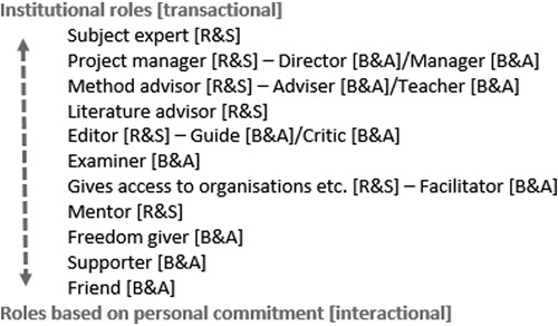
At the same time, you find yourself in the roles of adviser (e.g., helping to solve technical problems and suggesting alternatives), supporter (e.g., encouraging and exploring students’ interests and ideas), critic (e.g., observing the choices made during research and writing), and freedom giver (e.g., fostering students’ autonomy). Furthermore, whether you want to or not, you will act as a role model for the student: how you behave within the institute and conduct your research will influence and shape the student’s behaviour and attitudes (Van Loon et al., 2025).
It therefore requires practice and experience to define your role as a supervisor and recognise the responsibilities that come with it.
Skills and abilities of a supervisor
Since the supervisor’s roles and responsibilities have already been outlined, effective supervision involves more than just disciplinary knowledge. It also requires pedagogical tact, emotional intelligence, and the ability to adjust your approach to a student’s competence and motivation. Therefore, strong (intercultural) communication skills are essential, including listening, summarising, and digging deeper (LSD method), as well as asking open-ended questions (e.g., who, what, where, and how?). In essence, the supervisor’s skills enable students to take responsibility for their learning process.
The Massachusetts Institute of Technology (MIT, n.d.) highlighted the supervision skills they encourage their supervisors to cultivate:
- (Intercultural) Communication: setting up a communication method and frequency, and providing feedback.
- This article reflects on the experience of a Chinese international student working with her Dutch supervisor during her doctoral research.
- Project and duty scope: planning, structuring, and timelines.
- Flexibility, adaptability, and empathy: flow and adapt to the students’ process with compassion and respect.
- Documentation and organisation: keeping and reviewing (lab) notebook and notekeeping.
- Community: making the student feel comfortable within and part of the lab and/or workplace, introducing them to others (also in the field of research).
- Mentee career development: preparing and advising students on their career development and offering opportunities.
- Safety and proper lab procedures: learn and show reasonable lab procedures and discuss ethics around this kind of work.
- Scheduling: coordinating meetings, managing time effectively, and arranging work timeslots at the lab.
- Teaching new skills: giving the student the confidence and opportunity to learn new skills while letting them know it is ok not to be familiar with them. Assigning relevant literature and conducting constructive conversations about it.
- Holistic mentorship: involves mentoring them as a person, not just focusing on day-to-day tasks. This includes helping with struggles, balancing the workload, and having honest, genuine conversations with them.
Remember that you do not need to know everything, and that you can learn just as much from this supervision relationship as your student does. With supervision, you enrich the student’s learning process while, at the same time, offering you the opportunity to enhance your skill set
(among many other things).
Effective feedback
The intention of feedback should always be to help someone grow, develop, and flourish. When applied thoughtfully, it could also strengthen your relationship with the student. Below, we focus on how your feedback can help students develop their learning process and environment.
The text below is partly adapted from the University of Cambridge’s guide for its workshop for new undergraduate supervisors.
The most vital aspect to consider about feedback on student work is use, that is, how the student can use the feedback to improve learning and understanding (Carless and Boud, 2018). It is thus vital, when providing feedback on student work, to help students see what to do with it and how to take it forward into their next supervision work. Knowing when and how to use and deliver feedback is a skill in itself, and supervisors should support students in developing it. The four steps below are helpful while preparing your feedback:
- Strengths: What are the key strengths of this work?
- Limitations: Evaluate the work’s limitations.
- Learning: which one or two steps would have the most significant impact on the student’s next piece of work?
- Action points: make it practical by outlining one or two steps for the student to follow. (Consider revisiting the students’ initial learning goals before drafting action points. This ensures that feedback is clearly aligned with their goals, increasing its usefulness and impact.)
- The questions in this form of the Career Development Initiative (pages 10-13) can help you design questions that lead to a fruitful feedback discussion.
It is crucial to recognise students’ strengths not only to encourage positive motivational beliefs and self-esteem, but also because this recognition serves as constructive feedback. Students need to see what they are doing well as they develop their disciplinary knowledge and skills. It might also raise their confidence by highlighting positive things, and it might even motivate them to explore different perspectives and topics.
Clear is kind. Unclear is unkind. -Brené Brown (2021)
Equally important is translating feedback into clear action points and applying them effectively. When you give specific, actionable feedback, it helps students concentrate their efforts on bridging the gap between their current and desired performance. Therefore, share and describe your observations accurately, focus on the here and now, and be helpful and thoughtful. Always remember to review these action points in a subsequent meeting to see if the student has made progress on them.
Demanding situations and/or conflict
Whatever is happening, you need to continually adjust your strategies to keep the conversation with the student going. What do you do, for example, if a student you supervise does not keep to your agreements, for instance, by continually handing in work late? Two things are essential here:
- Work with the student to identify the cause of the problem and find a solution.
- Clearly indicate that you consider this to be a problem and what the consequences are.
- This may be a difficult conversation, but it is important not to postpone the conversation (UU, 2022).
Throughout this interaction, remember to see yourself and the student as distinct individuals with unique personalities and backgrounds. Control your emotions, communicate with clarity and respect, “see” the other person, and avoid reacting impulsively. Your main objective is to listen attentively and ask questions to grasp the students’ motivations, which will help in establishing a shared understanding for ongoing supervision.
If the conversation stops and the conflict begins, it is vital to keep any authority out of your tone of voice. Continue speaking persuasively, seek ways to negotiate, and focus on the student’s desires and needs, but in a win-win manner.
Reflection on your supervisory role
Reflective practice is a valuable tool for gaining insights and learning from your past actions. The most effective way to support your growth as a supervisor is through regular, ongoing discussions with your peers on this topic. Being a supervisor involves facing many situations and conversations you didn’t anticipate beforehand. This requires flexibility and adaptability in the moment, along with curiosity and reflection afterwards: what happened, why did it happen, and how can I approach it differently if it occurs again? Consider establishing a routine check-in at the end of each week with a prompt like, “What supervision moment surprised me?”, “What went well this week?”, or “What could I have done differently?” These brief reflections promote ongoing curiosity and help embed reflective habits into your routine. Or as Thompson (1996) puts it: read, ask, watch, feel, talk and think.
It can also serve as an opportunity to initiate or become part of an intervision group. This peer-learning environment can provide a platform to discuss supervision-related questions, such as:
- How do you balance guidance with stimulating autonomy?
- My student lacks motivation. How should I handle this?
- How can I navigate the cultural differences between myself and the student?
These conversations with peers reveal other supervision options, offer you the chance to choose between them, and ultimately help you to develop your own supervisory style.
It’s a joy to work with talented, innovative people who are bringing ideas that might refresh your research and perspectives, too. Building a solid and sound supervisory relationship creates space for enriching the learning experiences of both the student and you. It might even lead to new collaborations that enhance your field of research.